Why AI tutors don't work
They will be far less 'disruptive' than their cheerleaders claim

The claims made for AI tutors are seductive. As the DfE put it when announcing its AI tutor trial recently, “safe AI powered tutoring tools provid[e] personalised, one-to-one learning support – levelling the playing field for those who cannot afford private tutors.”
AI leaders go even further of course: Blair, Pinchai, Altman, Musk… they like to point to tutor bots as an innovation already upon us, a harbinger of a new era of educational abundance. Bill Gates anticipates massive disruption to schools and teaching. In the words of James O'Malley:
Whether we like it or not, once AI is in the classroom, it’s going to force massive structural changes in how schools work – including how we teach children.
I have been playing around with AI tutors for the past few years, and think we still have a long way to go.
Watching Tyler Cowen’s talk at UATX on AI and ‘the new life of the mind’, I felt he missed three shortcomings which have nothing to do with the more common criticisms of AI in education (cheating, hallucinations and cognitive offloading).
1. AI tutors depend on prior motivation
AI tutors lack motive power.
If a student is interested in a subject or otherwise motivated to learn it, an AI tutor might be useful. I want to learn how to grow vegetables, and LLMs have been invaluable.
Without prior motivation, the median student will find interacting with an AI tutor demoralising. Yes, the dreadful UX of platforms like this will improve but anyone with an Alexa can sympathise with the mix of indifference and contempt that is prompted by a robot’s emotional manipulation, whether carrot or stick.
Those who have tutored or been tutored by a human know that its chief fruit is not the quality of a tutor’s explanation but the mimetic, motivating power of the relationship established between tutor and tutee, in which the tutor takes a previously inert idea or topic and fuses it with life. As Gilbert Highet wrote decades ago,
“The business of the teacher is to pass currents of interest and energy through the facts so that they melt, fuse, become interconnected, acquire life, and grow into vital parts of the minds which hold them.”
Cowen recommends UATX students to read Homer accompanied by their AI - but who will energise them to read Homer in the first place?
For this reason, any benefit of AI tutors will likely accrue to autodidacts (like Cowen) or those strongly motivated to pass high-stakes exams, thereby exacerbating the Matthew Effect. I can see them working well for college preparation ecosystems like StudyHall for this reason.
Gains will correlate with, and depend on, the strong motivational cultures created by schools and human teachers, limiting AI tutors’ potential for the sort of ‘disruption’ dreamed of by their creators, and actively subverting the egalitarian hopes expressed by the DfE.
2. AI tutors are visually unappealing
Children are spending much of their childhood in front of a screen, to the increasing alarm of parents and health professionals. Before we introduce even more screen learning, prudence should suggest that we judge the experience to be so good that the reward outweighs the risk.
Peruse a typical AI tutoring platform and you will find it ugly, distracting and cheap. Using increasing pre-existing templates for design, they are themselves a manifestation of the deadening effect of AI on creativity and are almost always absent any form of beauty or delight.
As adults, we have all had enough of the emotional register demanded by the emoji or the placeless, genderless iconography of ‘infographic man’. Why are we putting it in front of children? What vision of life does it commend to them?
This sort of thing is typical: both visually over-stimulating but also banal and devitalising.
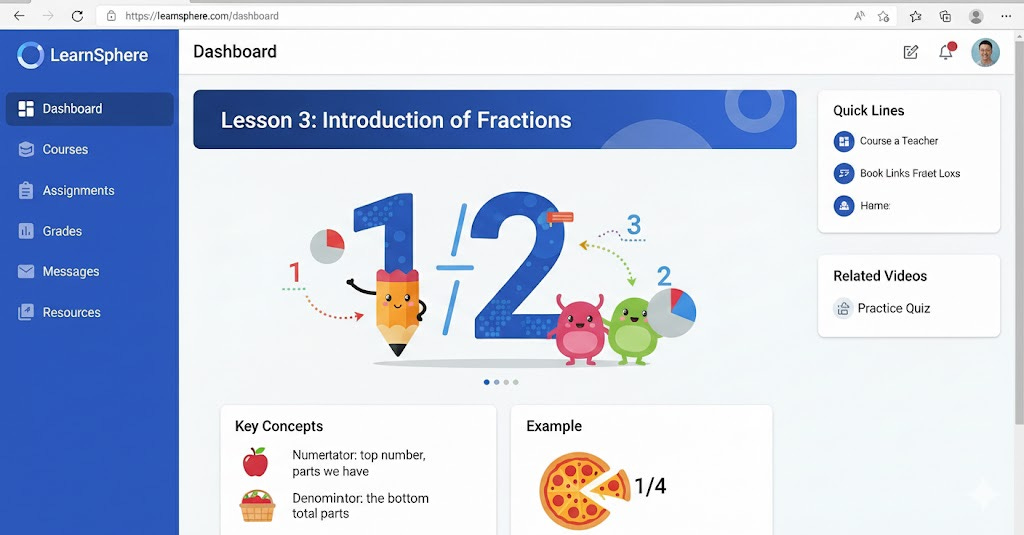
One of the great virtues of edtech like Anki or No More Marking is precisely their simple interface and aversion to cheap engagement tools employed by many of the AI tutors coming to market. Will the next generation of AI tutors be able to show such restraint?
3. AI tutors too often personalise to a child’s interests as well as learning gaps.
The hope with an AI tutor, like previous Intelligent Tutoring Systems, is that they will be able to identify poorly-grasped topics and help students to target their practice accordingly.
This is perhaps the biggest comparative advantage that an AI tutor possesses over a human teacher, who finds it hard to track learning gaps without good systems or software.
However, from my experience, perhaps motivated by the opportunity to market something meretricious to unaware buyers, AI tutors are as concerned with personalising the experience to a child’s interests as much as they are to their gaps.
On such platforms, users are asked about their interests during onboarding and are served tailored material accordingly: reading comprehensions featuring football, Maths questions using Harry Potter characters and so on.
Here is one school recommending why their pupils should use an AI tutor:
Create personalised learning experiences
Artificial Intelligence offers a great opportunity for personalizing children’s learning experiences. Through interactive Q&A sessions, AI can engage with a child to understand their preferences, hobbies, and interests and can then generate tailored content, recommend relevant resources, and even design customized quizzes or challenges that align with the child’s interests.
Alpha School makes the same case:
When your child loves Taylor Swift, algebra usually loses.
But what if the two could coexist—if math lessons riffed on concert logistics or world history unfolded like a global tour?
In doing so, AI tutor platforms are falling for the same mistakes and myths that the educational research community has been debunking for decades.
E D Hirsch, Daisy Christodoulou, Michael Young and so many others have shown that the success of the educational project relies of wresting children free of the “tyranny of the present” - their current interests and hobbies - and introducing them to canonical knowledge of enduring value. AI tutors’ design architecture points in the precise opposite direction. Children do not know what they do not know; too much personalisation gives them the message that their current horizon is the edge of the map, and avoids the harder job of enticing them to newer, better lands.
Conclusion
In her recent post revisiting some of her earlier reservations about LLM tutors, Daisy Christodoulou praises the AI platform Eedi as the best answer to four challenges encountered by most AI tutor products.
Eedi works alongside real human tutors, and in a classroom setting, so points the way to an AI tutor integration that overcomes many of my shortcomings too:
Firstly, it harnesses the successful motivational paradigm of schools and human teachers to inspire pupils to want to use it - and in a way that, unusually, possibly scales to subjects beyond Maths.
Secondly, whilst far from beautiful, and relying on AI slop prose (“great job!”) for its emotional register for students, it nonetheless seems to abjure the worst excesses of screen jazz for a fairly simple interface.
Lastly, embedded within school curricula, it does not allow students to personalise to their own interests, keeping the machine learning wizardry at work on identifying learning gaps.
At a recent AI conference at Eton, I was interested to see that Eton have taken much the same approach with their own guides (link here), which simply would not work without Eton’s edifice around it. I suspect that Eton’s new AI tutor (with the racy name of Caitlin) will fall down on Shortcoming 2 however.
Thoughts and challenges welcome. Is this a very 2026 objection, to be overcome in a few years time, or are these not bugs but features?
It strikes me that the short-term approach (“plug the knowledge gaps”) is overshadowing the human interaction behind good tutoring and what it can lead to. Screens are a lonely place for children to be interacting with essentially robots (see articles recently on dangerous way teenagers have become addicted to bots etc) . A good, empathetic tutor will be able to pick up on things like mood, motivation and interact accordingly to support that student. At best, tutors / teachers can also inspire and be incredibly effective . I do think most tutors in skills (rather than content) based subjects like English Language do know the strengths / weaknesses of their pupils without AI which often fails to pick up on e.g nuances in comprehensions etc.
Remember when Ofsted aspired to 'awe' in lessons? This is not where you find it.