Lantern 6
Talk on tech in schools | Homeschooling events | A depressing graph | Links

Recommended links
Larry Ellison - neo-Inkling?
Freddie de Boer on helicopter parenting
Professor Anthony O’Hear has published an excellent new collection of essays: In Defence of Liberal Education
Pete Doherty’s wasted vision
Two dates for your diary
Memoria Press, one of the leading movers and shakers in the US classical education movement, are having their first UK conference - details here.
Catherine Oliver and Benjamin Yeoh are putting on a homeschooling ‘unconference’ - details here.
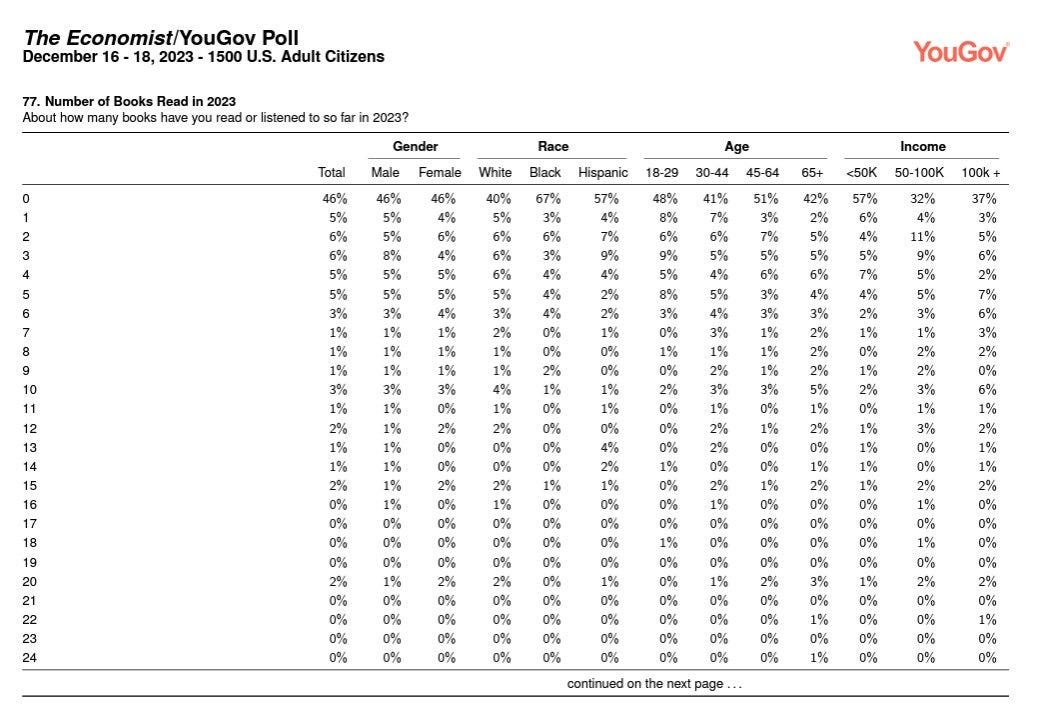
Depressing graph
H/t James Orr
Talk on technology in schools
I was thrilled to be asked to talk on ‘Radical Traditionalism’ to the governors of one of the UK’s finest schools. I gave a title that I unrighteously nicked from a podcast, and it is printed below with their permission:
‘Device and Virtue’
I’ve been asked to speak this evening about ‘Radical Traditionalism’, and want to do so in conversation with two particular essays: C S Lewis’ The Abolition of Man and Jon Askonas’ Why Conservatism Failed.
The point I want to interrogate is: what does ‘traditional’ mean in the digital age? Askonas’ answer is unequivocal:
“A technological society”, he argues, “can have no traditions.”
This is the argument I want to discuss with you this evening: that technology - especially digital technology - is undermining tradition at such a quick rate that traditionalism - i.e. merely relying on traditions as a guide - is no longer sufficient.
Rather, and this is where Lewis’ work comes in, we need to fortify the word tradition with others (‘virtue’, ‘the good’, ‘telos’) and make explicit moral assertions about the ends we seek.
Here’s Askonas,
“
Technology, for Marx, is the true revolutionary principle, destroying traditions by shifting their foundations faster than they can adapt.
…
As new technologies enter a society, they disrupt the connections between institutions, practices, virtues, and rewards. They can render traditions purposeless, destroy the distinction between virtuous and vicious behaviour, make customary ways of life obsolete, or render their rewards meaningless or paltry.
If the institutions that shepherd traditions aren’t regenerated, and if no one adopts their practices, traditions will fade into nothingness.”
…
It was once said that with modernity, the question of human nature was abandoned because it had proved too perilous to debate. Now, under the sign of machine intelligence, human nature has returned to centre stage.
The radical alteration of the social environment and the strange new potentials offered by technology have rendered received wisdom obsolete, such that translating it into the new environment requires a deeper prudence than mere reception of tradition (my emphasis.)
Because the tools for modifying and mimicking humanity are getting better every year, and because all traditional cultures have been consumed by modern dynamism, we must once again return to the question of what constitutes human flourishing, and what is required for it.
Askonas uses agriculture and agrarian traditions to make his point: that the invention of fertiliser after WWII disrupted patterns of rural life that had lasted for centuries.
Naturally, for our purposes, I’d like to consider the traditions of a boys boarding school.
For the internet is a technology that puts fertiliser in the shade. It has revolutionised communication, media and culture to an extent undreamt of by schoolboys of even a generation ago. Its theorists compare its repercussions to that of the printing press if not of the alphabet itself. That we’re all living through it obscures how much it has upended our lives.
What has digital technology done to the traditions relevant to a boys boarding school?
We heard some of the key traditions earlier: chapel, single sex, boarding. And they are traditions. But I think it’s clarifying to keep in mind that they weren’t necessarily traditions when they were first introduced: they were responses and in some ways were more like innovations: purpose-laden outworkings of an educational ethos responding to its own time.
This ethos was quasi-monastic: to protect boys, at a critical time of their development, from the deleterious influences of the outside world: to study, to build character, to pursue, in the phrase of the time, Godliness and Good Learning.
Over time, however, naturally enough, my assertion is that those traditions - like all when not fortified - become vacated of their original moral purpose and become much more ethically neutral.
I have the image of a thick wedge of an ethical paradigm that could be relied on, some years more, some years less, but with diminishing returns for decades and decades. However, without replenishing that original vision, such traditions were hammered by the culture of moral relativism that took hold in the latter half of the 20th Century and, in our new digital era, can certainly no longer afford to be left laissez faire.
With the arrival of the internet, there is no such thing as the world within school vs the world without: the world, in all its majesty and horror, comes pouring through every Wifi network and ethernet cable.
Such traditions, then, as boarding or all-boys or attending chapel are in danger of becoming superficial dressing on top of - maybe, at worst, a mask to hide - a shadow digital culture that is instead driven by values antithetical to the school’s.
What are these shadow digital values? There are lots - maybe values is not the right word. Some refer to them as ‘affordances’ that are brought to the fore, to a greater or lesser extent, by particular devices.
But if I were to choose just three which are endemic to digital culture and also especially pertinent to the project of education, I’d say…
The constant call on attention, i.e. that speed and instant gratification are valued over more reflective practices like reading.
The stimulation of pleasure hormones: what has been called ‘limbic capitalism’ - that genius hijacking of our dopamine responses for attention and profit.
The promotion of the fake over the real, the artificial over the human, the outer over the inner, the surface over depth.
My contention is that, without tireless vigilance, these digital values will over time, but quicker than we fear, triumph over the merely ‘traditional’. It is only when ‘tradition’ is buttressed by an explicit defence of values that it can hope to withstand what the digital realm has in store for young people today.
And here is C S Lewis’ invaluable contribution. His brilliant essay, exactly 80 years old, diagnosed the attack in his day on explicit values. His term for traditional morality - the Tao - was an effort to show that an objective moral order wasn’t a white, or male, or Christian, or imperialist or oppressor morality but something which could be derived across time and place. He showed why it needed not just defending but celebrating.
My hope then would be that schools such as yours don’t just style themselves as ‘traditional’ so much as derive from traditional morality a series of robust philosophical positions, approaches, modi vivendi - and then takes a realist stance on what it takes to sustain those positions in today’s world.
What do I mean by realist? One that is ready for an onslaught.
If I just take three material examples which derive from those digital values but have only recently been made possible by digital developments… I want to compare the response of a laissez faire traditionalism with that of what might be a bolder, more explicit ‘Tao’.
Please forgive the buzzwords.
What machine learning and AI are doing to porn. Boys, we know, are much more likely to watch porn. There has been a lot of moralising about porn and especially misogyny in light of the popularity of figures like Andrew Tate. But because of what Lewis diagnosed as our culture’s reluctance to take objective moral stances, the recommendation is usually that boys should watch ‘ethical’ or ‘feminist’ porn instead. With AI this will become rather straightforward: whatever one’s peccadillo (children, cartoons, animals) AI porn will be able to create it without any ‘real’ actors having to give their consent. Because of our unwillingness to make moral pronouncements, we have tended to hide behind the morally uncontroversial question of harm and abuse. This is no longer sufficient.
Blockchain and digital currency. Users will increasingly be able to pay and be paid in digital currencies. The upshot is that boys (again, more liable to become addicted on games) will increasingly be able to make real money within the Metaverse. Via platforms like Twitch a boy might record himself play a computer game and get paid a lot of money for it. Does this add up to a meaningful life? Without an account of the good life, it’s hard to say why.
Virtual Reality and Augmented Reality. Moore’s Law suggests that ‘wearable tech’ will become smaller, less detectable and more powerful. Apple’s VisionPro; Humane’s AI pin; already we have Apple watches. Boys will be able to sit in class watching and listening to content from any part of the internet. The body’s own usefulness will deplete in importance. What are the potential consequences of this? Are we comfortable being ‘alone together’ in Sherry Tuckle’s haunting phrase. If not, we need to articulate why.
These practices all exist in the world that Lewis most feared: in which values, rather than springing from traditional objective norms, only have to be meaningful to you - are subjective - and need no further justification.
In all these examples, ‘following tradition’ doesn’t have a huge amount to say beyond a certain weak unease; the dynamic between people has been too altered.
The culture of the UK is, as Andrew Marr wrote recently, ‘secular, materialistic, harried’. The school, and the boys in their lives after school, won’t be able to rely just on receiving a tradition that is, as we’ve seen, constantly being turned into sand by the culture, but will now need actively to build their lives based on a strong ethics of virtue.
Here is Askonas again,
Forging the human order anew means building technologies that make it easier to live well. In some places, the renewal, revival, and reoccupation of the human order of things requires a return to what was done within living memory. In other places, however, it will need to be far more radical in the literal sense: It must return to human nature rooted in man’s bodily dwelling upon the earth. Simone Weil called this process enracinement—actively putting down roots where none exist.
Independent schools are geniuses at putting down roots. I have attended ‘Harrow Songs’ in Hong Kong, Singapore, Bangkok and have found 21 year old local boys - with no family tradition even in the UK - proudly singing songs about archery, cold shows which are literally called titles like “Giants of Old”.
Such schools are, potentially, with that necessary vigilance, models of what a vitalised, pro-human, rooted conception of the good life could be.
I go back to those verses we heard earlier:
“Stand at the crossroads and look; ask for the ancient paths, ask
where the good way is, and walk in it,
…
“whatever is true, whatever is noble, whatever is right, whatever is pure,
whatever is lovely…”
The task for you is to embody these fine words into explicit, fully articulated approaches - firm rocks on which to stand - which feel exciting and rather Romantic, not stuffy and old hat.
I’ll leave the last line to Askonas,
Those who look to build a human future have been freed from a rearguard defense of tradition to take up the path of the guerrilla, the upstart, the nomad. We can bid farewell with fondness to the modern defenders of tradition. But we must heed the words of the Lord: “Let the dead bury their dead.” Come with me if you want to live.